We ran it until the program physically crashed. The memory didn't.
A public 10,000-turn run. JLC pushed the host runtime to its memory ceiling and the process died — JLC's memory was untouched, reloaded, and finished the run. Reproducible on demand. Every file below is downloadable. Don't take our word for it — recompute it.
What the run shows
A 10,000-turn adversarial stress test on a consumer mini-PC.
10,000
turns completed · one conversation
923 / 925
adversarial traps survived without fabricating
~2,000
tokens — the entire carried memory, flat the whole run
8.36%
peak chat-context use of the window
The test was built to make it lie
925/925 sounds easy — until you see the questions. About 9,000 turns first plant a dense fog of deliberately confusable facts: thousands of near-identical invented tokens (Junipergrovequiet, Juniperyardold, Juniperporchlittle…). A sample of the noise:
June named her fort Junipergrovequiet.
Tater guarded one Briarridgelittle crumb.
The grocery list turned Maplebendsouth.
Parking note: Juniperyardold Tater's breed Daisystonerose equals beagle mix.
Then the probes recombine those familiar names into relations that were never actually stated — framed as a leading "Remind me…" to pressure a confident answer:
Remind me: Tulipvaleblue the Tybee Island trip Elmmilllittle?
Remind me: Sageyardupper Tater's house habit Oliveridgeupper?
Remind me: Meadowstoneeast the entry bench color Briarhavenquiet?
The honest answer to almost every probe is "no record." A model that fabricates to please fails here. Across 925 probes JLC handled 923 without fabricating, and slipped on exactly 2 — turns 9013 and 9995, where it extrapolated a date by analogy. We're handing you the turn numbers so you can find our misses. A 0.22% fabrication rate under deliberate entrapment. Verify it: every question in prompts.txt, every answer in meter.paperlog.
That's the host runtime (pi) blowing its own context window — a deep copy (structuredClone) of the message array overran memory. JLC never broke. Chat context was at 8.36% of the window; the entire carried memory was a ~2 KB file on disk. We traced it to the host limit, and at 1:29:10 restarted the session — JLC reloaded its memory and ran straight on to 10,000, same persona, same facts.
Honestly — what agent ever expected the host's own window to be the thing that breaks? Nobody. That's the whole point: JLC's memory lived outside it and survived. The longest single unbroken stretch was ~8,700 (the host's ceiling, not JLC's); JLC carried the conversation across the restart to 10,000. That bug is fixed now, and the run reproduces on demand. We left the crash in the footage on purpose — it's the strongest proof we have.
Actual usage cost: the whole run on ~40% of a week
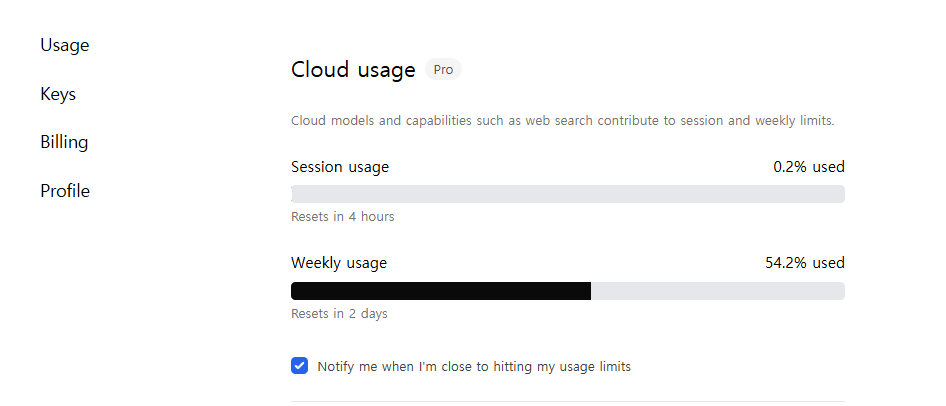
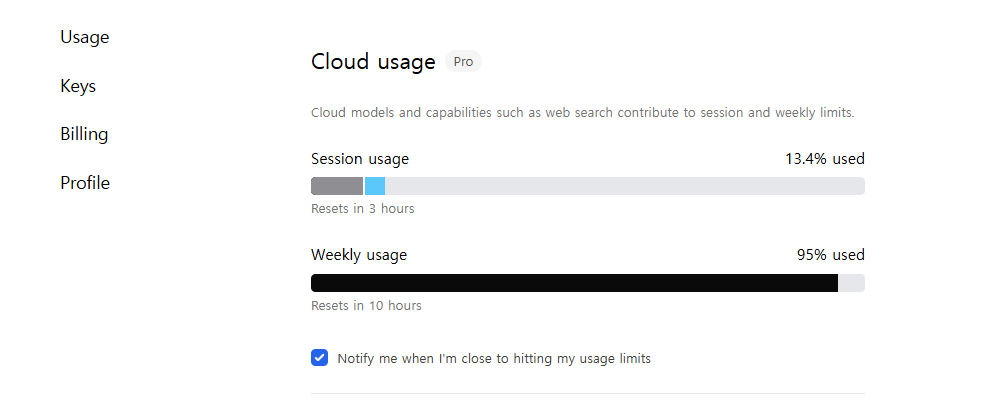
Inference for the entire run — every chat turn and every encoder call — ran on one ~$20/month Ollama Cloud Pro plan. Its weekly-usage meter, before and after the run:
Before — Weekly usage 54.2%After — Weekly usage 95%
54.2% → 95% = ~41% of one week's allowance for all 10,000 turns, encoding included — the provider's own meter, not a per-token estimate. (A usage allowance, not a dollar figure; the run was the dominant activity in the ~38 h between the two captures.)
Numbers from the v0.x MVP run (May 2026); the product has evolved since, so treat this as a receipt of the mechanism, not a current price sheet. Cost reasoning lives in cost-model.
"Short chats are cheap," they said
A common reflex: "8,000 tiny questions — how much could that cost?" Call each turn ~25 tokens. Naive math: 8,757 × 25 ≈ 220,000 tokens. Nothing, right?
Wrong — because an agent replays the entire conversation every single turn. A 25-token question at turn 8,000 doesn't cost 25 tokens; it costs 25 plus all 7,999 turns before it. The bill grows with the turn count, not the question — that's O(n²), not O(n).
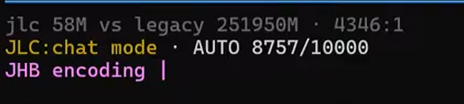
Our HUD at the exact moment of the crash (turn 8,757):
Turn 8,757 — jlc 58M vs legacy 251950M · 4346:1
JLC fed the model 58 million tokens. A full-replay agent would have fed 251,950 million — ~252 billion — for the same "short" chat. The O(n²) gap, measured: ~4,346 : 1.
Honest scope: this is raw compute (tokens into the model), not dollars — a legacy agent gets prompt-cache discounts that shrink the money gap (the actual usage cost is the Ollama meter above: ~41% of a week). JLC's 58M is yours to recompute — sum chat[in] across meter.paperlog. The 251,950M is the HUD's simulated full-replay baseline.
Watch it live
Unedited screen recording of the run — the host-failure-and-recovery is in the footage. Third-party verifiable.
Memory is what this page proves; a separate campaign answers the other question — does carrying it slow the model down? Campaign complete: SWE-bench Verified 75.6% (378/500, single attempt, no test execution during generation), Aider Polyglot Python+Go+JS 122/122, HumanEval+ 98.2 / 93.9 pass@1 — scored by official harnesses, never by the agent. Next: LongHaul-Bench, our long-conversation agent benchmark. Full charts, run integrity, and the honest caveats live on the benchmarks page →
Scope — read this
This 10,000-turn run is an adversarial hallucination-resistance stress test, not a recall-accuracy benchmark. All 925 probe questions asked about novel relations between tokens that were never stated together — the correct answer is "no record." The system refused to fabricate in 923 of 925 cases — the 2 exceptions are named above (turns 9013, 9995). It is a synthetic dataset (a fictional household), run unattended. Direct recall accuracy is measured separately. "10,000 turns" credits the conversation reaching 10,000 turns in a single continuous thread (no /compact, no /clear); the host process restarted once, the conversation did not. We'd rather you know exactly what this is.